

The Major Pentatonic Scale on Guitar
The major pentatonic scale is one of the most useful and musical scales on guitar. It has a bright, uplifting sound and is widely used in styles such as pop, rock, country, funk, reggae and soul. By learning the G major pentatonic scale, you’ll develop strong melodic phrasing and gain a clear understanding of how lead lines fit over major chords and progressions.
What Is the Major Pentatonic Scale?
The major pentatonic scale is a five-note scale derived from the major scale. By removing two notes that can create tension, the scale sounds open, smooth and easy to use in many musical situations.
Its formula is:
1 – 2 – 3 – 5 – 6
For example, the G major pentatonic scale contains the notes:
G – A – B – D – E – G
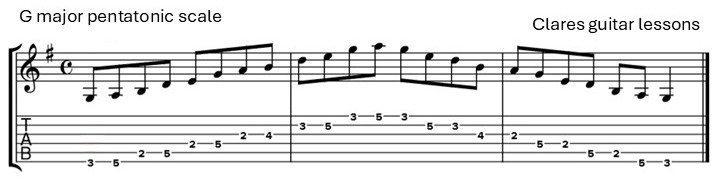
Here’s the G major pentatonic scale starting on the 3rd fet of the 6th dtring:
Why Learn the G Major Pentatonic Scale on Guitar?
- It’s ideal for creating melodic solos and lead lines
- It works perfectly over G major chords and progressions
- It’s widely used in pop, country, funk, and classic rock
- It improves phrasing, timing, and melodic awareness
- It helps connect lead playing with chord shapes
G Major Pentatonic Scale Shapes on the Guitar
On guitar, the G major pentatonic scale is played using movable shapes across the fretboard. Learning these shapes allows you to:
- Play in any key by shifting the pattern
- Move smoothly between fretboard positions
- Recognise repeating shapes and note relationships
- Combine major and minor pentatonic scales for richer solos
Next Steps
Start by learning one G major pentatonic shape slowly and cleanly. Focus on accuracy, timing, and musical phrasing rather than speed. Once comfortable, connect the shapes and experiment with mixing the G major pentatonic with the E minor pentatonic (its relative minor) to create more expressive and dynamic solos.